
 This article traces the evolution over time of sexuality in fantasy literary works and science fiction.
Dear reader, if this tedious introduction has just made you yawn, don’t run away! Because if you keep reading, you’ll discover stories of arses, penises and testicles, all more or less outlandish. Sex with aliens, vampires, or with yourself thanks to time travel machines.
And to top it all, with this, you can pretend you’ve read a heap of books. But watch out, spoilers on the horizon.
Ancient science fiction and testicles
The novel “True Histories”, a work written in Greek by the Syrian writer Lucian of Samosata in the 2nd century, is sometimes called the “first science fiction story in Western literature”. But this label is the subject of heated debates among SF fans.
The hero’s ship is swept up into the air by a storm and ends up on the Moon.
The Moon turns out to be populated solely by male individuals. They reproduce by giving birth through the thigh, or by planting their left testicle in the ground so that a baby tree grows. The lunar king offers him his son, the prince, in marriage.
The villain’s sex in the story
Then, you’ll have to wait until the 20th century for the nice characters in fantasy works to be allowed to have a bit of fun again.
Up to that point, unbridled sexuality is reserved for barbarian and underdeveloped creatures and for demonic beings.
Gulliver and the sexuality of the Yahoos
In “Gulliver’s Travels” by Jonathan Swift (1921), the hero lands with the Houyhnhnms, intelligent and wise horses. They use repugnant draught beasts that strangely resemble humans, the Yahoos, with dirty and obscene customs.
Carmilla, young lesbian vampire girl
Carmilla, created by Joseph Sheridan Le Fanu in 1872 in a novel of the same name, is a young lesbian vampire girl.
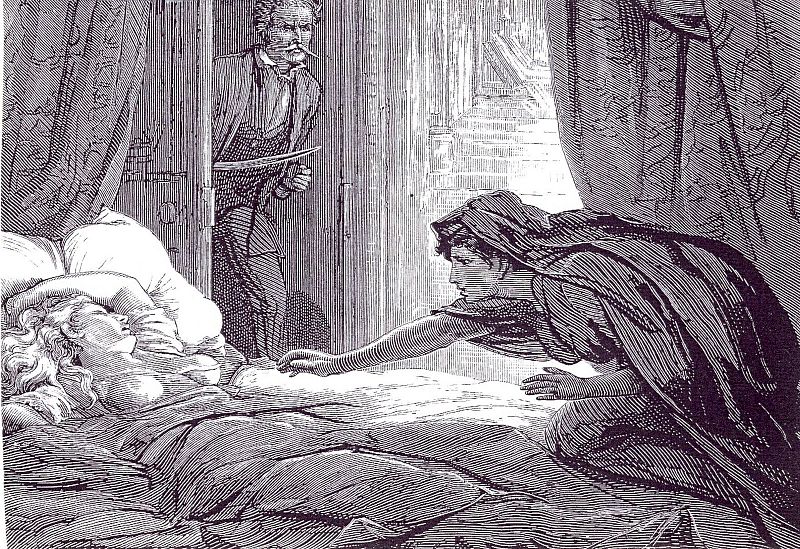
She courts her victim and regularly turns into a cat. The aim? To come and discreetly nibble her jugular vein, thus making her die a slow death.
The pulp magazines era
In the 1920s and 1930s, the pulps, an abbreviation for “pulp magazines”, were very popular in the United States.
These publications got their name from the poor-quality paper, made of very coarse wood fibre, on which they were printed (“woodpulp”). Cheap, they generally cost the modest sum of 10 cents.
Pulp magazines mainly published fiction. Their themes, very varied, ranged from romance to fantasy, through detective fiction and science fiction.
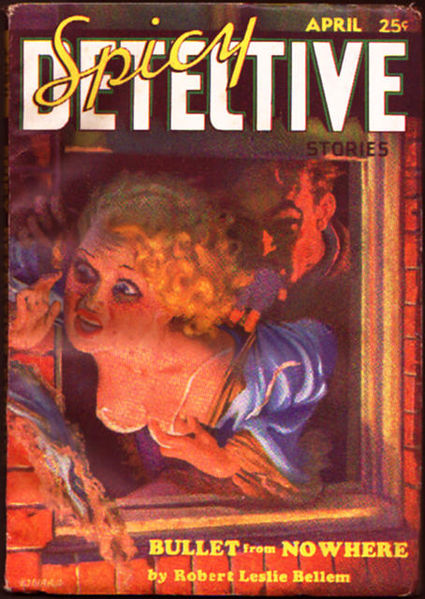
For a long time, rather prudish publishers felt the need to protect the adolescent male readership, identified as their main marketing target.
The covers of some magazines were rather alluring, showing outrageously dressed maidens trying to escape from tentacled creatures. However, their content was generally much chaster.
Odd John and the Oedipus complex
The novel “Odd John”, written by Olaf Stapledon in 1935, is one of the first 20th-century science fiction works mentioning unconventional sexual acts. Its title would literally translate as “Bizarre John”.
John is a mutant with superhuman mental abilities: an “übermensch”, a German word that would translate as “overman”. It is in German because the author, who was English, really liked Nietzsche.
Our super-mutant refuses to conform to the rules of society. He therefore decides to have sex with his mum, and to seduce a boy older than him.
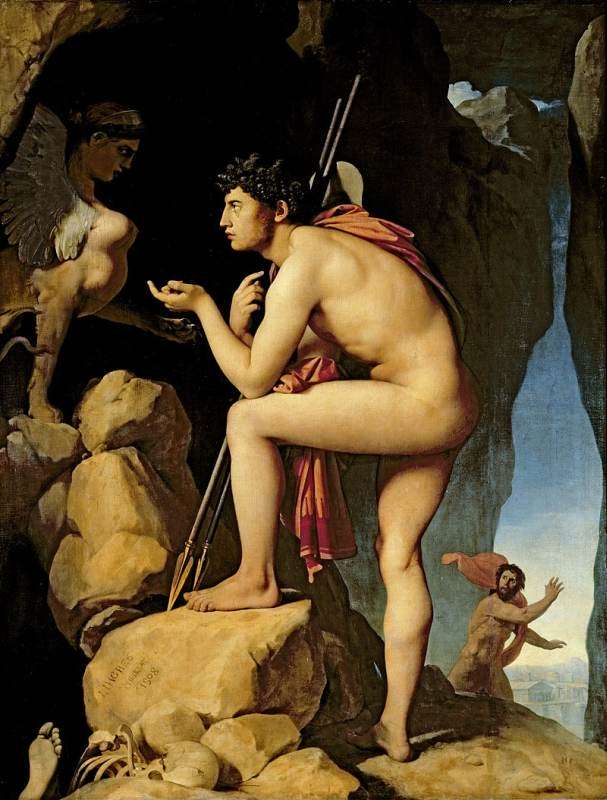
He still asks himself some ethical questions about his relationships… And he eventually concludes that any sexual interaction with “normal” humans is akin to bestiality. He is rather full of himself, that mutant, after all!
The 1950s: the start of sex in SF
The Dirbanu, homophobic aliens
In 1953, Theodore Sturgeon writes “The World Well Lost”, a science fiction short story in which a pair of extraterrestrials arrives on Earth.
The couple is especially cute, and the two aliens are immediately well liked by humans, thanks to their grace and obvious love.
They are therefore nicknamed the “Loverbirds”, the turtledoves, by the media. Their species is already known to Earthlings: they are the Dirbanu. The ambassador from their planet has deigned to visit Earth only once, and openly expressed his disgust.
However, the silence is broken by the Dirbanu government, which requests the extradition of the Loverbirds couple, because they are fugitive criminals. Earth, to make a good impression, decides to cooperate, and tasks two inseparable astronauts with this mission.
While one of the two astronauts is napping, the other realises that the Loverbirds, who are telepaths, have found out one of his most deeply buried secrets. But what is this secret? In any case, he turns out to be ready to kill them to prevent it from being revealed.
But, fortunately, the Loverbirds are clever. They draw him little sketches to explain that, although one of them resembles a man and the other a woman, both are male Dirbanu. As for female Dirbanu, they are pot-bellied and short-legged creatures.
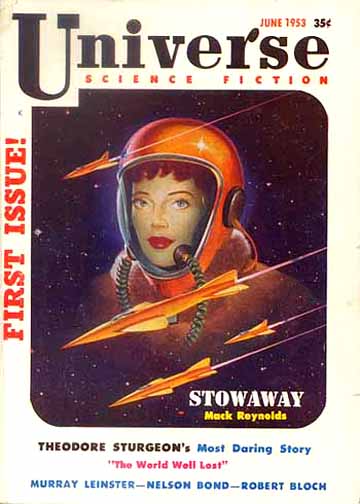
And unluckily, those bloody Dirbanu are homophobic! Hence the turtledove couple’s escape, and the ambassador’s revulsion for Earth, which, for him, is a bit of a planet where blokes are having sex.
The astronaut, who is secretly in love with his mate, understands their situation, and sets them free. So that was his famous secret! No need to make a big deal of it!
Once arrived on the Dirbanu planet, the Dirbanu, quite eager for the humans to get out, don’t make too much fuss when he makes them believe the Loverbirds died en route. Finally, our two heroes can quietly set off on the return journey.
Theodore Sturgeon had a bit of a struggle to get his book published. So there, humans, Dirbanu, same fight…
How to love yourself? With a time travel machine
In “All You Zombies”, written in 1958 by Robert A. Heinlein, the hero, armed with a time travel machine, manages to… Wait, it’s a bit complicated.
Edit : Spoiler alert! This short story was adapted for film: it’s the film Predestination (available on Netflix). If you’re planning to watch it, skip quickly to the next paragraph!
Right, we’ll start at birth. At first, it’s a girl who is a hermaphrodite without knowing it. She grows up in an orphanage, then meets a guy, with whom she sleeps and finds herself pregnant. Except that this guy, actually, was a version of her from the future, sent there by a version of her from a more distant future.
The birth goes badly, so they have to turn her into a guy to save her. Her far-future version takes the opportunity to nick the baby and deposit it in the orphanage, on the date on which she was deposited in the orphanage. In short, the baby was also her.
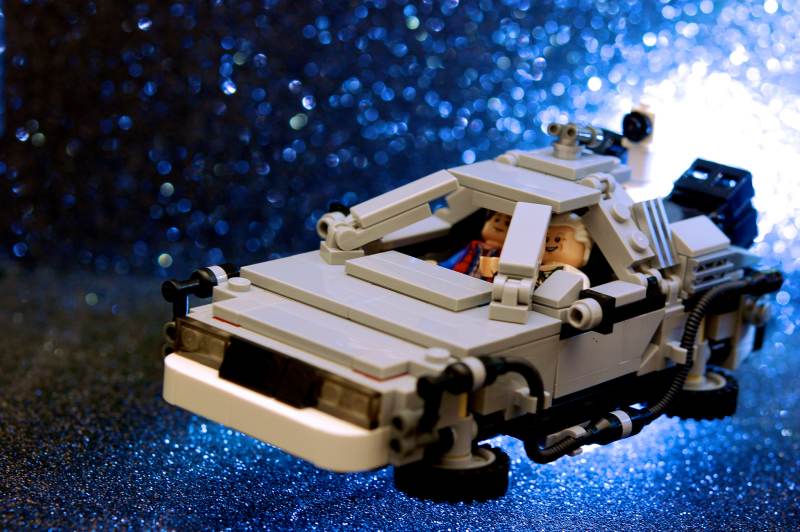
Right, to sum up: time travel really makes a bit of a mess!
To secure her existence, our heroine, who is also a hero, had to create a whole bungled mess in order to self-fertilise, just to become her own father and her own mother. If you’ve got lost along the way in this infinite loop, don’t worry, you’re probably not the only ones.
1960s: sexuality and science fiction join forces
The sun, the stag and his penis
In “Flesh”, a novel written in 1960 by Philip José Farmer, sex is omnipresent. Literally translated, the title of this work means “flesh”.
The hero, Peter Stagg, leaves Earth with other astronauts in the year 2100. In English, “stag” means stag. Important detail for what follows.
Thanks to this wonderful technology that is the hypersomnia, they return to Earth 800 years later. And there, surprise and drama! The planet has become a rocky world, devastated, populated by strange pagan societies.
He meets a group, mainly made up of women, who graft antlers onto his head, in stag style, and christen him “Hero of the Sun”. In the end, this glorious title turns out to be rather shite. In reality, it makes him a sex slave. The sun gets the blame. Our poor hero therefore finds himself obliged to have sex with nearly all the girls in the group, the virgins first. He therefore asks himself a host of existential questions. He too… Decidedly…

Despite his popularity as a phallus on legs, when he actually falls in love, the object of his affection refuses his advances.
This book did not get a unanimous reaction from critics. Although most appreciated Farmer’s style, many blamed him for penning the plot as a feeble pretext for stringing together sex scenes. Let’s admit that this female gang bang story has a slight porn film script side.
Extraterrestrial orgies, female cloning and other curiosities
Subsequently, alternative sexual practices in science fiction diversify and become commonplace. Sexuality and science fiction become intimately linked.
Asimov and the third sex
In “The Gods themselves” (“The Gods Themselves”), in 1972, Isaac Asimov describes an extraterrestrial species with three genders, all three playing a role in reproduction.
Members of this species must have three-way sex in order to procreate. Hence social and sexual norms different from ours. In the same novel, he discusses the risks and problems associated with sex in weightlessness.
Exclusively female colonies and reproduction
In “When it changed”, also in 1972, Joanna Russ describes a human colony in which the men have been exterminated by an epidemic, thirty generations earlier.
The women therefore reproduce by in vitro fertilisation. They have no need of men at all and worry about the arrival of male astronauts on their planets. One of them tries to kill the astronauts. And the one who prevents her regrets in part having allowed the astronauts to survive, worrying about the changes to come associated with their presence.
This concept of an entirely female society that does not at all wish for the presence of men among them is revisited in 1976 by James Tiptree, Jr., alias Alice Sheldon, in “Houston, Houston, Do You Read?”.
In this book, the girls are more radical. They study the astronauts and take some sperm samples, just to diversify their genotype, hitherto invariant, because they reproduce by cloning. But afterwards, they definitely intend to kill the astronauts.
Castration, androgynes and fetishists
In 1967, in “Aye, and Gomorrah”, Samuel R. Delany describes a world in which the astronauts, called “Spacers”, are castrated before puberty, whether they are originally male or female individuals. The aim: to avoid the mutagenic effects of stellar radiation on the gametes.
This results in androgynous adults, whose original sex is hard to determine. Fetishists are sexually attracted to these astronauts, who are unfazed and unapproachable. The Spacers take advantage of this attraction to have fun and earn money by prostituting themselves. But, in a way, it is also about their escaping loneliness and reclaiming their lost sexuality.
Illustration and sources
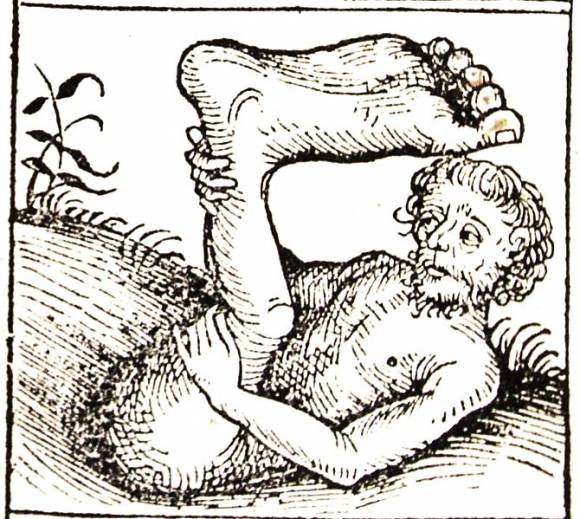
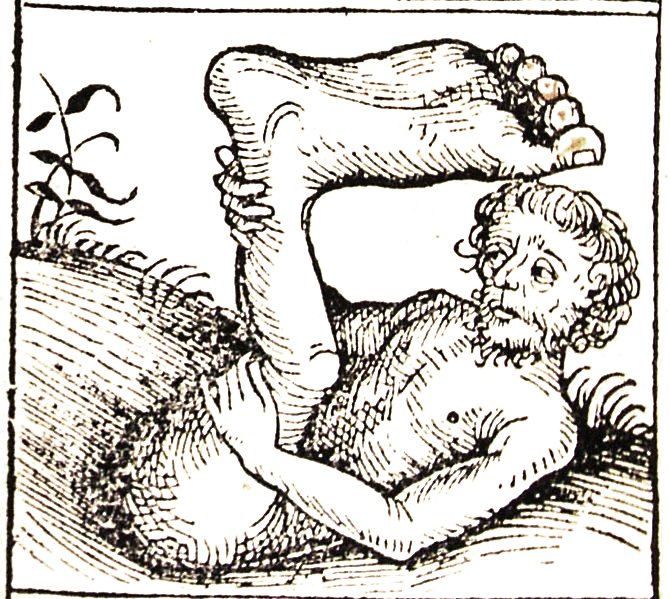
The image at the top of the article represents a sciapod. These creatures were popularised by Ctesias of Cnidus, one of the ancient authors parodied in True Histories.
The sciapod in question is not currently performing any obscene feat. It is simply using its giant foot as a parasol. The illustration, which dates from 1493, is a woodcut from Hartmann Schedel’s “Nuremberg Chronicles”.
This article draws its sources from this English Wikipedia article, of which I have summarised and translated certain excerpts.