
In France, Moncuq is the most famous of the towns with erotic names.
And I’ve already told you, in passing during a quiz, about the town of Condom, in Gers, which, despite its suggestive name, still doesn’t have a museum of condoms.

To the great delight of curious souls like us, Condom and Moncuq are far from the only towns saddled with names that have sexual connotations.
So let’s set off on a virtual tour of places whose names are the butt of smutty jokes.
Towns with erotic names in France
Gland
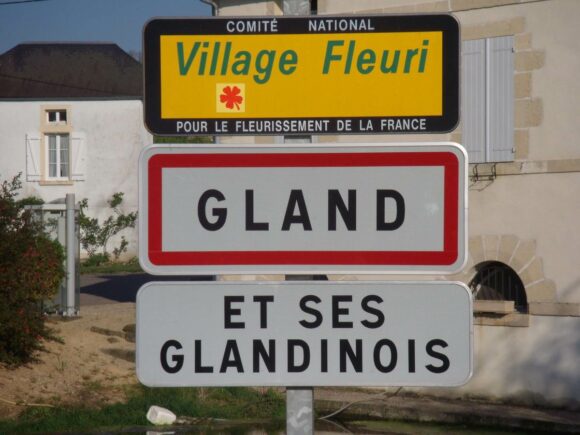
The village of Gland, in Yonne, was probably named after the acorn. Even so, those with dirty minds will immediately think of something else.

Its residents are called Glandinois, and proudly say so on the town sign, just to make sure nobody mistakes them for lazy layabouts.
Deux-Verges
Deux-Verges, in Cantal, has been depicted by two jokers in a rather suggestive way…

The etymology of this curious name is unclear. The oldest known name for the municipality of Deux-Verges is “Duae Virgiae”, which could come from the Old Provençal “verga”, meaning “branch”, or “verge”, meaning “virgin”. Originally, it was probably the name of an inn.
Verges
Verges is a small village in Jura. Its residents are called Vergeois and Vergeoises.

Sainte-Verge
The municipality of Sainte-Verge, in the Deux-Sèvres département, in Poitou-Charentes, takes its phallic place name pretty well.

In fact, its local council has joined the Association of French Municipalities with Funny and Musical Names. It brings together municipalities and hamlets “whose suggestive names make you smile or laugh, or whose musicality evokes the picturesque and folklore”, with the aim of promoting their image.
Originally, this story of a blessed rod had absolutely nothing to do with penises. Verge, an old variant of the name Virginie, is the suggestive name of a young shepherdess who, according to local legends, lived in the 4th century on an estate called la Forêt.
Le Fion
Le Fion is a hamlet belonging to the municipality of Chevenoz, in Haute-Savoie.

Its rather unusual name makes a little more sense when you know that “en fion” is an old expression meaning “by the water’s edge”.
What’s more, a tributary of the Marne, which has nothing to do with Le Fion, is also called the Fion.
Anus
Anus, in Yonne, is a place name in the municipality of Fouronnes. “Fouronnes”, not “Foufounes”, as some pranksters would have you believe after they doctored the sign.

Duranus
Duranus, in Alpes-Maritimes, is my favourite, because its name with its anal connotations also makes me think of the Durandil swords from The Dungeon of Naheulbeuk.

Sexfontaines
Sexfontaines, in Haute-Marne, was once known as Saissefontaine , after the House of Saissefontaine, which ruled the area from the 11th to the 13th century.

Corps-Nuds
Corps-Nuds, in Ille-et-Vilaine, is also a member of the Association of French Municipalities with Funny and Musical Names.
Originally, the very old town was called “Cornut” or “Cornuz”, a name inherited from its first inhabitants, the Gallic tribe of the Carnutes.

But in the Middle Ages, some overzealous scribes, perhaps thinking they were correcting a spelling mistake, or simply wanting to play a schoolboyish prank, decided to replace “Cornut” with “Corps-Nuds” in official documents. Copyist monks could be real jokers sometimes.
Saïx
The name of the town of Saïx, in Tarn, comes from the Latin “saxum”, meaning “rock”.

The diaeresis was added recently to make it easier to read, as the name had often caused confusion. In fact, it’s pronounced “sa-heess”, not “sex”, as tourists sometimes think.
Froidcul
Froidcul is a place name in the municipality of Moyeuvre-Grande, in Moselle.

In winter, your arse gets a bit cold there: perhaps that’s where its name comes from.
Boullay-les-Troux
Boullay-les-Troux is a municipality in Essonne, with a population of Boullaisiens and Boullaisienes.
The two parts of its name, which fit together so well, have different roots.

The word “Boullay” probably comes from the Gaulish “betua”, meaning “place planted with birch trees”.
As for “Troux”, it may be connected with the stone quarries that the villagers worked for a long time.
La Trique
La Trique is a hamlet belonging to the municipality of La Chapelle Largeau, in the Deux-Sèvres département.

Montcuq
There’s no need to introduce Montcuq, made famous in the 1970s by the sketch by Pierre Bonte and Daniel Prévost.

Monteton
Monteton, in Lot-et-Garonne, is also part of the Association of French Municipalities with Funny Names.
The origin of its name remains a mystery. The village of Monteton sits at the top of a rounded hill that looks like a breast. That’s one possible explanation.

But the explanation may be far less erotic: in the Middle Ages, Aquitaine was invaded by barbarian hordes from the East, including the Teutons. “Monteton” could then be an abbreviation of “Mont Teuton”.
Chatte
The town of Chatte, in Isère, regularly has problems with sign theft. Its mayor and residents really aren’t amused, as replacing and reinforcing the signs is getting expensive.

After a Fun Radio listener stole a sign, with the presenters’ blessing as they welcomed the thief and his spoils onto the show, the town council decided not to take it lying down and called in a lawyer. The matter was eventually settled amicably, as the radio station agreed to put on a free concert in Chatte in 2014.
Lorgies
Several theories have been put forward about the origin of the name of the municipality of Lorgies, in Pas-de-Calais, which is also part of the association of municipalities with funny names.

This funny name could come from the word “lorgia”, which meant “hut” in the Middle Ages, or it might have something to do with growing barley.
Another possibility is more grim: the village was supposedly conquered around the Celtic period, during a bloody battle whose participants and details are unknown.
This grim episode may have earned Lorgies its gloomy name (“boundary stones of the field of misfortune”), along with three neighbouring villages: Herlies (“battlefield”), Illies (“field of misfortune”), and Marquillies (“destroyed and put in chains”). In short, it’s a good deal less inviting than the sound of its name suggests.
Bèze
Bèze, in the Côte-d’Or département, is also part of the famous association. The name “Bèze” is thought to come from the Gaulish “bedon” or “bedu”, meaning “canal” or “ditch”.

There is also a river of the same name, the Bèze, which flows through the village of Bèze.

Fourqueux
Fourqueux, in Yvelines, owes its name to the ferns (filcusas) that covered its forests in the Middle Ages. The place was first called “Fulcosium”, then its name evolved as its population grew, becoming “Fulcosa“, then “Forquensa”, “Fourqueusa”, “Fourqueus”, and finally “Fourqueux” in the 16th century.
Its residents are called Foulqueusiens or, more commonly, Fourqueusiens.

Bezons
Bezons is a town in Val-d’Oise.

Jouy
The municipality of Jouy is in Eure-et-Loir. Its residents are called Joviens.
“Jouy” comes from the Latin name “gaudium”, meaning “joy”. Lots of villages have this name, including Jouy-en-Josas in Yvelines, Jouy-le-Moutier in Val-d’Oise, Jouy-sur-Morin in Seine-et-Marne and Jouy-en-Argonne, in Meuse.

Towns with erotic names around the world
Dildo
Well, I’ve already told you about Dildo, in Canada, whose name means “dildo”… Dildo is one of the world’s most famous towns with an erotic name.

Fucking

Fucking is a village in Austria, which seems to owe its name to a 6th-century figure named Lord Fucko.
In Old German, the suffix “ing” means “the people”. Fucking could therefore be translated as “At Fucko’s”.
Strangely, tourists, who aren’t very interested in etymology, rarely go for this historical interpretation, and have a nasty habit of filming themselves at the entrance to the village while miming explicit sexual positions — which the residents don’t much care for.
What’s more, the village is regularly the victim of sign theft, to the point that the signs have had to be planted in concrete blocks and fitted with surveillance cameras.
A vote was held in 2004 on whether to change the name. But despite these mishaps, the majority of residents refused to let the village of Fucking stop being called Fucking.
Well, it’s true that when there’s a sign under the one announcing the entrance to Fucking that says “Please — not so fast”, and “Please” is “Bitte”, it’s hard not to have a stupid laugh.

Penistone
Penistone is a town in the UK. Taken literally, you could crudely translate its name as “Penis tone” (“penis” / “tone”) or “Penis stone” (“penis” / “stone”).
In reality, “Penistone” is made up of the Welsh root “penn”, meaning “end”, “head” or “hill”, the term “is”, meaning “under”, and the suffix “ton”, which translates as “estate”. So the name “Penistone” means “the town under the hill”.

Intercourse
In English, “intercourse” means “sexual relations”.
The town of Intercourse, in Pennsylvania (in the United States), whose population is Amish and which is very popular with tourists, has problems with sign theft too.

“Intercourse” also means “communication”, and that is probably what gave the town its name; it was originally called “Cross Keys”.
For one thing, it lies at the intersection of two famous roads, two major communication routes. For another, the village’s first residents were very proud of their community spirit, based on social interaction and mutual support, which was also often referred to as “intercourse”.
Blue Ball
In English slang, “blue balls” refers to epididymal hypertension, better known as the “blue balls phenomenon”: the harmless pain in the testicles that can occur after prolonged sexual arousal.
The town of Blue Ball, in Pennsylvania (United States), is located right next to Intercourse.

Its name comes from the Blue Ball Hotel, a building constructed in the 18th century, with a blue ball hanging in front of it.
Mount Wank
In English, “wank” means “masturbation”. That’s why Mount Wank, in Germany (in the Bavarian Pre-Alps), makes English speakers laugh so much.

Mount Wank has a cable car, the Wankbahn, which has been running since 1929. Hence the retro 1930s posters titled “Wank”, which, if you were being a little disingenuous, could be translated as “Wank!”.

Twatt
In English, “twat” is a vulgar word for the female genitals (it’s also an insult, much like “con” in French).
There are two places called Twatt in Scotland’s islands. The name of these places probably comes from the Old Norse “þveit”, meaning “small plot of land”.


Signs showing the directions to Twatt in the Orkney Islands (left) and Twatt in the Shetland Islands (right). (Source: Wikipedia, Creative Commons)