

People often talk about the problem of phthalates in sex toys. But what exactly is a phthalate? How are these substances harmful? And above all, how can you avoid them?
When you use a sex toy or a “consumable” erotic product (lubricant, stimulant gel, etc.), it comes into contact with your mucous membranes. And if it contains harmful chemicals, they can enter your body.
Admittedly, with the nasties in processed foods and pollution, there are plenty of opportunities to come into contact with toxic substances. You may have decided not to think about it, so you don’t have to worry about it. But if the subject concerns you, you probably want to choose sex toys and erotic products that are safe for your body. And it’s not always easy to get clear information about this.
A long time ago, we published an overview on this blog of phthalates in sex toys, along with the various harmful compounds that may be present in lubricants, particularly parabens. We’ve decided to publish an updated version.
Let’s start with the question of phthalates.
Phthalates are endocrine disruptors, found in many types of packaging and everyday consumer products, as well as in some sex toys.
In 2018, in France, what is the legislation on phthalates? How can you tell whether a sex toy contains phthalates, or rather, how can you make sure it doesn’t?
What are phthalates?
Phthalates are toxic substances that have been detected in a multitude of everyday consumer products: shower curtains, waterproof clothing, cosmetics, food packaging, and even children’s toys, food packaging and, according to an analysis carried out in 2009 by two laboratories, Nutella (in tiny quantities, admittedly, but still, Nutella is something you eat…)!
And also, in some sex toys.
Phthalates are used to make plastics that are originally rigid flexible and elastic, at low cost.
Risks to the body
Seven phthalates have officially been classified as “carcinogenic, mutagenic and toxic to reproduction”, and are also suspected of being endocrine disruptors.
In short, the risks include cancers, foetal abnormalities, reduced fertility, and a whole host of delights linked to hormonal imbalances.
Legislation
In May 2011, a bill seeking to ban products containing phthalates, parabens and alkylphenols was passed by French MPs. But this law has still not come into force.
Six types of phthalates have been banned (restricted to 0.1%) in children’s toys in the European Union. But when it comes to adult toys, it’s another story.
DEHP (with its lovely little name, di-2-ethylhexyl phthalate), the most toxic phthalate (it’s the one in Nutella—would you care for another slice?) and the most widespread, BBP (benzyl butyl) and DBP (dibutyl) were taken off the market by the European Union between 2014 and 2015, under the REACH Regulation (“Regulation concerning the Registration, Evaluation and Authorisation of Chemicals”).
In the meantime, it is still possible for sex toys to contain phthalates. In particular, some jelly and vinyl sex toys, and some soft PVC sex toys.
How can you spot phthalates in sex toys?
The problem is that sometimes it’s difficult to know.
If the absence of phthalates is explicitly stated, in theory, it should be OK. In theory. But a shop can’t always verify what every manufacturer says. There are few checks and few regulations on the composition of sex toys, and some manufacturers lie, without risking much, even when their lies are proven by independent organisations such as Dildology.
Signs of phthalates in sex toys
A few clues that might make you suspicious (or rather, put you on your guard by touch, smell, taste…) and make you wary:
A soft object “made of PVC”: beware, phthalates or other additives!
PVC is a rigid material. If you come across a soft object “made of PVC”, substances have been mixed into the PVC to soften it.
These might be phthalates (toxic), mineral oils (toxic) or other stuff (magic dust, a pinch of owl feathers, or whatever…)… Either way, it’s a bad sign.
The smell: beware!
If it stinks, it’s dodgy. If a sex toy has a strong plastic smell, and the smell comes back after washing, it’s because molecules are making their way from inside the sex toy to its surface.
The molecules in question could be all sorts of things, but the thought that, on their little wander, they’ll end up on the parts of your body that come into contact with the toy is pretty worrying… And, in practical terms, a smell like a tyre left in the sun isn’t exactly a libido booster, so if possible, best avoided…
A chemical taste: yuck
If you find, when you put a sex toy in your mouth, that it has a disgusting chemical taste (or even stings), same deal: you may have just ingested phthalates, mineral oils or another compound that’s not necessarily any less harmful. Bon appétit…
A sex toy that seeps
If a sex toy seeps (even all by itself, shut away in an airtight box—yes, yes, it’s possible): same deal.
A change in colour
If a sex toy changes colour: there are two possibilities.
Either your sex toy is made of nasty materials and is starting to disintegrate. Or the culprit is another sex toy that has “melted” onto it without warning. When toxic sex toys come into contact with one another, they can literally melt in places (chemical reactions and all that) and take out any healthy sex toys you may have left nearby.
Below, as an example, two old “jelly” sex toys that haven’t survived the ravages of time very well.
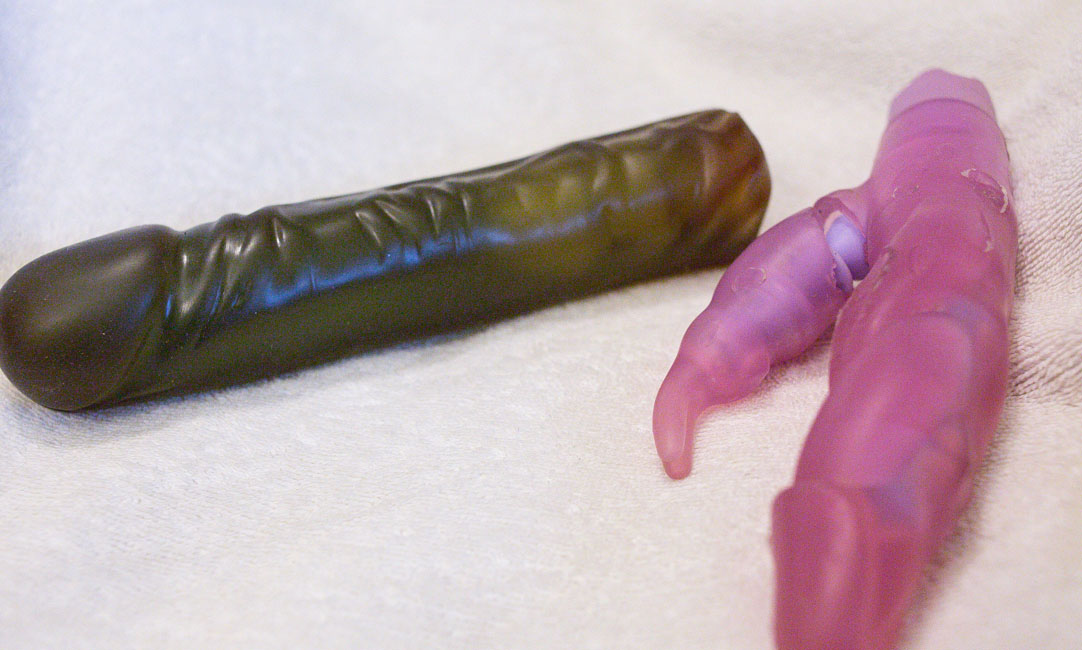
On the left, the dildo from Doc Johnson’s Briana harness, made of “jelly”, which has changed colour. On the right, a rabbit whose name I can’t remember, which has melted in places. The Briana harness dildo was originally a bright blue, and of course had no yellowish marks on it at all. Since the photo was taken, it’s been stored in a red velvet pouch and has become even more disgusting, gradually taking on the colour of the fabric.
Materials without phthalates
However, some materials never contain phthalates. In particular:
- 100% medical-grade silicone
- VixSkin, which is a blend containing only silicones
- Silicone elastomers
- Thermoplastic elastomers (TPE)
- Glass
- Ceramic
- Wood
- Metal: sex toys are available in stainless steel, aluminium (although aluminium sex toys generally have a coating intended to make them safe to use, we still have doubts about them because of the health risks of aluminium) and even gold-plated metal!

A wooden dildo (Nobessence Fling)
What about “realistic” sex toys?
Many “realistic” sex toys (that is, designed to imitate skin, visually and/or to the touch) are made from materials patented by the brands that produce them: Cyberskin, Superskin, UR3, Ultraskin, Softskin, etc.
These names are just marketing labels, and don’t tell us much about the chemical composition. And the information you can find is often contradictory. The trick is to work out whether the source is reliable or not.
Here’s some information I’ve managed to gather from sites that seem credible to me.
The manufacturers of Cyberskin and Softskin sex toys refuse to reveal all their ingredients to consumers, claiming that their formula is “top secret”. (Yeah. Generally, when you hide something, it’s rarely because it’s too cool to share with everyone else…)
As for phthalates:
Sex toys with phthalates (or likely to contain phthalates)
- Softskin contains phthalates. (see source)
- R5 (or Doc Johnson Realistic©) contains phthalates.
- The term Sil-a-gel (or Silagel), which appears in descriptions of some Doc Johnson sex toys (usually touted for its “antibacterial properties”), does not refer to the main material the sex toy is made of, but to a simple additive. As this additive is patented, its composition is unknown. Although the name of the substance starts with “sil”, it isn’t silicone. Sex toys made with “Sil-a-gel” are porous, so it’s impossible to disinfect them completely, as their pores can harbour bacteria. Some Sil-a-gel sex toys contain phthalates, despite Doc Johnson claiming otherwise: this is the case with the “James Deen Realistic Cock” dildo, which an analysis commissioned from an independent lab by Dildology found to contain 61.1% phthalates and 38.9% PVC.
- Plastisol is a flexible plastic material made by mixing PVC with a liquid plasticiser. The most common plasticisers are phthalates.
Sex toys without phthalates, but porous
Sex toys made of porous materials have many disadvantages that affect hygiene and comfort of use:
- They sometimes have an unpleasant chemical smell.
- It’s impossible to disinfect them completely, because bacteria can build up in their pores.
- They can deteriorate over time. Their colours and details can also gradually fade. To look after them properly, you need to coat them with talcum powder after every wash.
- A greasy deposit can form on the surface of some of these materials while they’re being stored. It’s not very appealing.
But not all porous sex toys are necessarily toxic.
Superskin
Superskin, the material used to make Fleshlights, does not contain phthalates.
Cyberskin
A Cyberskin sex toy (a “cyber pussy”) was tested by Greenpeace (along with various other sex toys). It didn’t contain phthalates, and I think Greenpeace can be trusted when it comes to the validity of this analysis.
According to Topco, which owns the “Cyberskin” patent, the same is true of all Cyberskin sex toys. (But what do they contain? A mystery…)
UR3
UR3 (also called Ultra Skin), a material used by Doc Johnson, is a thermoplastic elastomer, a mixture of PVC and silicone. It apparently doesn’t contain phthalates (see source).
Sex toys without phthalates and non-porous
Hard plastic
Hard plastic sex toys have no reason to contain phthalates, since phthalates are used to soften plastic. (But the hardness of the material slightly spoils the “realistic” effect.)
Medical-grade silicone
Sex toys labelled “medical-grade silicone“, “100% silicone” or “platinum silicone” are made of pure silicone, and therefore contain no toxic substances.
Be careful: if a sex toy advertised as being “made of silicone” doesn’t carry one of these labels, it may be a blend containing enough silicone to qualify for the name (which tells us nothing about the rest of its composition).
VixSkin
VixSkin (harder on the inside, softer on the outside, patented by Vixen Creations) is made of 100% silicone. So it doesn’t contain any phthalates or other nasties.
Material information: VixSkin.
Truskyn
Doc Johnson’s Truskyn is also made of double-density medical-grade silicone.

Four “realistic” sex toys made of pure silicone, and therefore guaranteed to be phthalate-free: the Tantus Vamp, Vixen Creations’ Goodfella, Fleshjack Boys Jason Visconti and the Tantus Max O2.
In a future article, I’ll tell you about lubricants, and the ingredients to avoid in them.