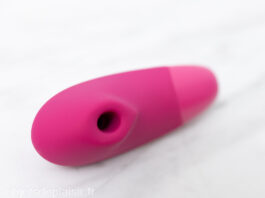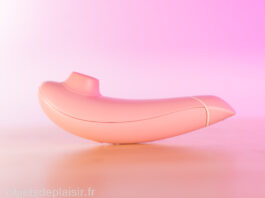


The brand Womanizer presents the Premium Eco, an “eco-friendly sex toy”. A crowdfunding campaign on Indiegogo to launch the device began in March and has far exceeded its initial target. Among other things, the shell of the Womanizer Premium Eco is said to be made from “Biolene”, a biodegradable material replacing the plastic used in the original model.

But is this initiative driven by a genuine desire to protect the environment? Or is it simply an attempt at greenwashing? It’s a fair question.
The Womanizer One: an anti-eco marketing stunt
Before suddenly deciding it was time to make love to the trees, Womanizer was more on the naughty list when it came to the environment.
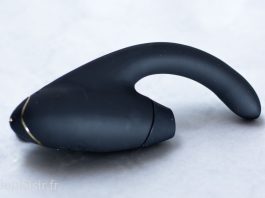
In fact, last October, it launched the Womanizer One, a disposable sex toy. This air-pulse clitoral stimulator works for 30 minutes before breaking down for good, irreversibly, once its battery runs out. Planned obsolescence taken to the extreme.
Some shops decided to offer the device as a free gift with orders, while others preferred to sell it as a “tester” so you could find out whether you liked or disliked the sensations a Womanizer provides before making a more expensive purchase.
Not wanting to be left behind, its competitor Satisfyer immediately hit back with the One Night Stand, an equally short-lived toy.
This dubious marketing stunt was met with a pretty frosty reception. To be fair, with the many tragic consequences of climate change and pollution, chucking plastic around left, right and centre is no longer viewed very favourably. At a time when brands are trying harder than ever to present themselves as eco-friendly, backed by a barrage of PR campaigns and with no shortage of hypocrisy, how could Womanizer and Satisfyer have failed to anticipate such a flop?
What’s more, with the Womanizer One, the German brand shows that it could easily bring an affordable model to market if it wanted to. But it chooses not to, crippling a device that could have made a perfectly decent sex toy if they hadn’t decided to condemn it to die after a ridiculously short period of use. In a way, the message could be interpreted as “fuck the poor, we’d rather destroy our product than let you have it at a low price”.
One good thing about these disposable sex toys, though: they’ll keep the tinkerers busy, and they’ll find a way to make them last much longer than intended. Disassembly tutorials for the Satisfyer One Night Stand have been available on YouTube for ages.
What makes the Womanizer Premium Eco eco-friendly?
By launching the Womanizer Premium Eco, the brand is trying to repair its image when it comes to the environment. This sex toy promises to be almost identical to the Womanizer Premium (which really packs a punch, so you probably won’t be disappointed with the sensations), but in an eco-friendly version.
But what makes the Womanizer Premium Eco eco-friendly? Let’s take a closer look at the product presentation.
Donations to a charity
The brand has pledged to plant a tree for every Womanizer Premium Eco purchased, and to donate all the funds raised by the Indiegogo campaign (minus the platform fees and taxes) to “One Tree Planted”, a charity that plants trees.
More specifically, the proceeds will help a cooperative of Rwandan women who are trying to restore their land and establish sustainable agriculture. Well, on that point, there’s nothing to say: it’s unquestionably a good thing.
However, I can’t help wondering about the size of the pot. Its initial target is 16,805 euros, and at the time I’m looking at the page, it’s reached 21,559 euros. Minus taxes and the platform’s cut, that is. It seems like a huge amount to us. But is it really a lot of money for Womanizer? Womanizer belongs to the Wowtech group, which also owns the Arcwave, We Vibe, Romp and Attivia brands. The brand makes no secret of it: in 2020, the group’s turnover reached 100 million euros.
A biodegradable material: Biolene
To make the Womanizer Premium Eco, the brand has replaced ABS plastic with Biolene. This biodegradable material (in an industrial setting, they point out—obviously, the device won’t just break down on its own) comes from renewable raw materials, mainly maize flour. Here too, in itself, that’s a good thing.
But is it really all that innovative? For example, PLA, or polylactic acid, which is used to make filaments for 3D printers, also comes from corn starch and is biodegradable too. And it’s far from the only bioplastic.
However, biodegradable materials are indeed not commonly used in the sex toy industry. Let’s hope that one of the best-known brands getting on board helps to start a trend.
Eco-friendly vibrators? What about their predecessors?
Well, we have to admit that, so far, the various PR stunts to flog us a supposedly eco-friendly sex toy haven’t really been any more sophisticated.
It’s worth noting that when people talk about an “eco-friendly sex toy”, they often mean an “eco-friendly vibrator”. Otherwise, take a look at the wooden dildos from Idée du Désir or Bobtoys, and your quest will end at once with the discovery of the Holy Grail.
A little over a decade ago, the Earth Angel came out: an Irish sex toy, probably the most sincere one of the lot. But to be fair, the device—a rigid vibrator, rechargeable with a hand crank and not much to look at—wasn’t exactly a dream.

After that, well… things became a bit of a circus.
In 2017, the Blush Novelties brand boasted about producing the first biodegradable sex toy, the Gaia Eco Vibrator. But since it ran on batteries, the whole thing was a bit of a joke.

Other than that, there’s a lot of jostling when it comes to eco-friendly claims, but the press often confuses “eco-friendly” with “safe for the body”. Although both things matter, they aren’t necessarily related.
Easy to dismantle
The Womanizer Premium Eco is easy to dismantle. That remains to be seen, but in principle, it’s cool. Provided it means owners of a Womanizer Premium Eco can repair their device themselves, replacing only the faulty part.
Does the brand plan to sell spare parts? It doesn’t seem to mention anything along those lines, merely pointing out that recycling will then be easier. But if we’re talking about standard electronic components, there’s nothing stopping you from getting them elsewhere, so on the face of it, that’s a positive.
A shorter charging cable
Supposedly to minimise waste, but, er… What? Isn’t this just plain and simple stinginess with the cable?
When you buy a sex toy (or any other device) that comes with a charging cable, you probably aren’t planning to chuck the cable in the bin as soon as it arrives. And if the socket is too far away, the brand giving you a cable that’s too short won’t bring the socket any closer. At best, you’ll resign yourself to leaving your sex toy on the floor by the socket while it charges. At worst, you’ll be seriously pissed off and decide to buy a new cable on Amazon. So much for an eco-friendly initiative.
Eco-friendly packaging
The packaging for the Womanizer Premium Eco contains no plastic, and its storage pouch is made from ethically sourced organic cotton.
This is all very good too. But if the environment really matters to the brand, why doesn’t it decide to apply this approach to all its products? Has a buyer (or tester) ever complained about there not being enough plastic in the packaging?
It’s worth noting that Womanizer (like most sex toy brands, sadly) still has all its products made (including the Premium Eco, presumably, although the vibrator’s Indiegogo campaign doesn’t say) in China. Perhaps eco-friendly and humanitarian, but only up to a point. Do they mention the product’s carbon footprint? The working conditions (which we know nothing about) of the people who make it?
In short, it’s a good initiative, but it’s not enough. It looks more like a publicity stunt dressed up as greenwashing by Womanizer than a genuine intention to transition its products to a more environmentally friendly model. Let’s hope, though, that it gives other brands some good ideas.